Multiple V-Curves Question!

I have Robo Focus up and running and really love it so far but noticed that in addition to running the First Light Wizard, there is an option to add multiple V-Curves…What advantages does this have on performance, how many should I run in addition to the First Light Wizard and what filter should I use for the Wizard and or additional V-Curves. Currently I have it setup with the Luminance filter but have a traditional setup with LRGB and SHO filters.

Thanks in advance !

Brad Draper, Majestic Skies OB

I use the luminance filter also. I generally do about 5 curves to average the result a bit. I can’t say that’s a best practice but it is what I do. Hopefully Leo will make a recommendation.

Best,

Glenn

Thanks, what is suggested by Glenn it is correct.
Generallyy adding more vcurves is needed when you have oscillating values to average it. Filter do not affect the vcurve , use the most light gathering like the luminance and nothing else of different.

Advantage of more vcurve is averaging parameters and get better step values for the focuser, but remember RoboFire is an AI Autofocus so every focus is corrected by AI model dependings on your system learning.

All the best

2 Likes

Thanks Leo, Glenn, I greatly appreciate the info and help on this !

1 Like

As this question also applies to my setup, I thought I’d continue on this thread.

I have 2 short and one large refractor on the same mount and have been setting up Robofire in a demo version of the latest Voyager.

My step size range from the focuser fully in to fully out is about 4500 steps.

If I set focus manually, the position is at approximately 1200 steps, all things being perfect.

Now backlash… when I used SGP before I started playing with Voyager, over a night, the focus point in terms of the reported step position, reduced, so I had to manually focus and reset the focuser’s position to 1200 every night.

If I didn’t, eventually I would hit 0 steps (even though the focuser was not anywhere near physical zero).

Here’s the last 2 focus events, showing a clear reduction in the focuser step position but not physical position.

If I do another v curve, it will likely be another 20 steps lower, but still in focus.

My question - Voyager Robofire works better with multiple V curves…how many is enough?

How does the AI take care of backlash and an ever decreasing reported step position? I have added a large 150 steps on the backlash OUT (in Voyager, not the focuser driver) as this appears to be close to what’s needed.

As I’m not doing any serious imaging with this setup yet, I’m happy to make changes to get this right.

I need to know if the focuser position approaching zero steps over time due to backlash will be taken care of by the AI?

Mechanically I don’t think I have any other issue apart from a fair amount of backlash, which I may be able to reduce a bit if I try but it can have the opposite effect when cold, the focuser can be too tight and the motor stalls.
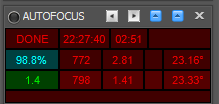
Jonk, if you get different readings over the night for the same position this means your focuser is slipping, that has nothing to do with backlash. You need to fix that, otherwise focusing will remain unreliable. I don‘t think you can compensate for it in software because it‘s inherently unpredictable how much it slips.

It’s not slipping because a) it’s an R&P focuser, no issue with the motor connection and b) it happens on all 3 of my scopes, one being a TEC140 with a Feathertouch focuser.

The common denominators are the focuser / driver (Sharpsky in my case) and the software.

As I mention, it’s happening in SGP and Voyager, it’s not a software issue, so it can only be the way Sharpsky reports the position.

The reason I brought it up here was I want to move to Voyager and AI focusing is mentioned, therefore AI should be able to recognise the reported position change, or at least a pattern so I wondered at what point AI would come into play if I did enough v-curves on different filters, different conditions, different parts of the sky etc.

I’m also going to write to Sharpsky to see what he says as I have total automation of a triple rig in a dome as my goal and I need to understand these things so I can make it work as I need it to work.

If you have different readings for the same focus position, something is slipping. And if it slips on all of your scopes, the problem is inside the focus motor. I see the Sharpsky one is marked as absolute positioning and has a rotary encoder - that could also be skipping encoder positions.

Positioning via stepper motors even without a closed loop is extremely exact unless something slips in the drive.

Yes I agree, steppers should be perfectly fine for positioning - I use 3D printers and xyz stage controllers at work so I understand this.

I’ve just written to Dave, the Sharpsky designer and I will also re-fit my Lakeside focuser and run the same tests to see if there’s any correlation.

I don’t suspect slippage, I suspect a Sharpsky or Ascom software issue, but I can’t prove this, he needs to look into it.

I don’t want to detract from the original thread question about v-curves, but it would be great to know how AI works with focusing, so I can understand, improve and trust my setup to be repeatable and reliable.